Your balance, and what happens if it runs out
How prepaid credit is spent, why your balance is not what you can spend, and the exact ladder from a warning to a suspended account.
Verified on August 13, 2026
The platform is prepaid: you hold a balance, your running environments consume it, and invoices are settled from it. Nothing is charged to a card you left on file, and nothing is charged after the fact.
That has one consequence worth reading this page for. A balance that looks healthy can already be spent, and the number that tells you so is not the big one at the top.
Balance is not what you can spend
The Billing page opens on your prepaid balance. Underneath it are three lines, and the third is the one that matters:
- Monthly usage — what your running environments cost per month, added up. This is your burn rate.
- Required to add capacity — what you must have available before you can create, start or resize anything. Where a tax applies to your country, it is included, because that is what you will pay.
- Unpaid invoices — subtracted from your balance before any of the above is judged.
The platform reasons about balance minus unpaid invoices. A balance of 18 000 with 45 000 unpaid is not 18 000 of room; it is a shortfall of 27 000, and the coverage line will say zero days.
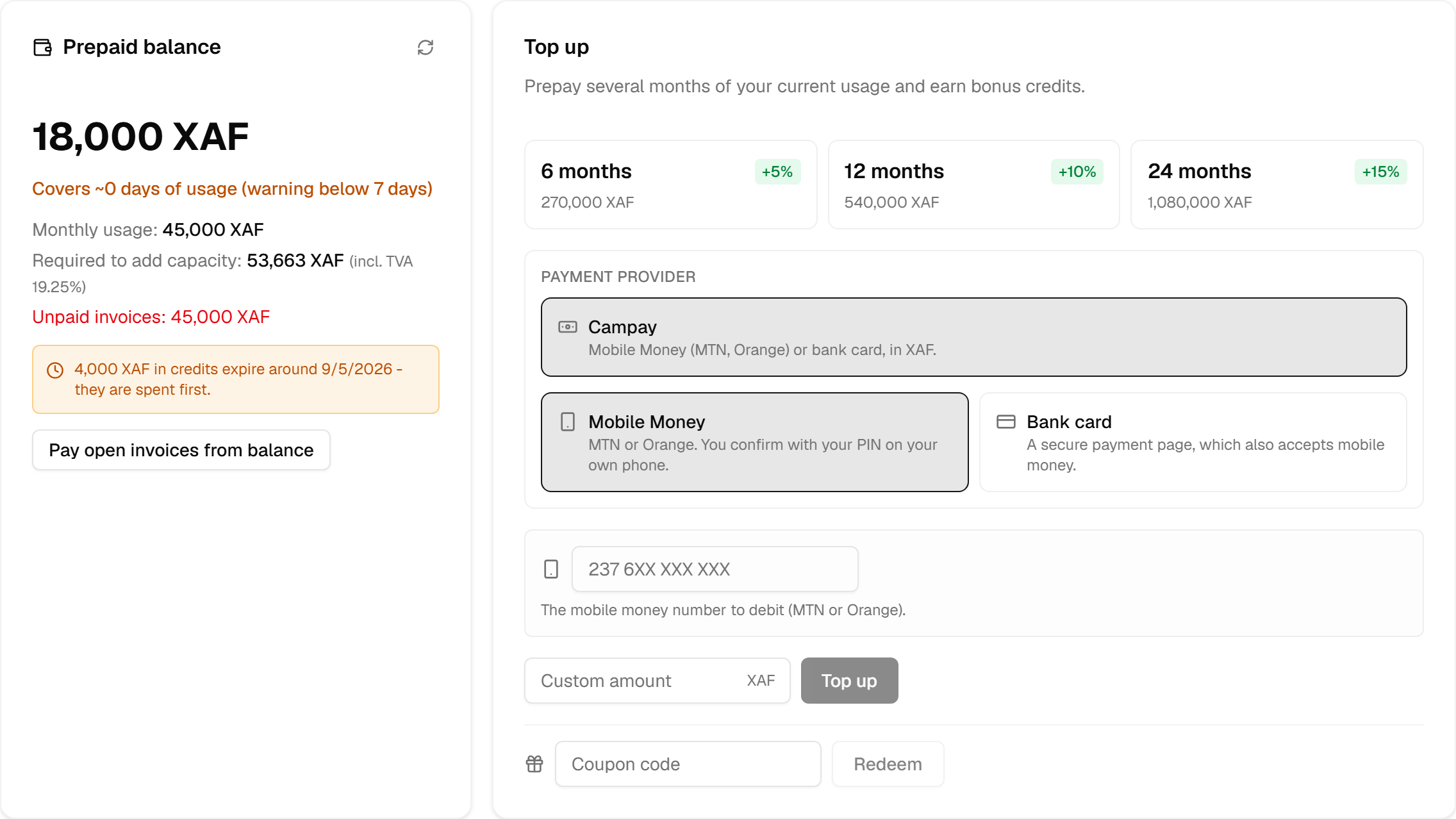
The coverage line — covers ~N days of usage — is that arithmetic turned into the unit you actually think in. It is available balance, after debt, divided by your monthly burn.
Topping up, and why months buy more
Top-up amounts are offered as months of your current usage rather than as round numbers, because the question being answered is "how long am I covered for", not "how much money is this".
Prepaying more months earns bonus credit: the tiers show the percentage next to each one. The bonus is real credit in the same balance, with one difference explained in the next section.
The payment methods offered are the ones that can take your billing currency, which follows your billing country. Today that means mobile money and a hosted card page for XAF; a currency with no rail wired says so plainly instead of failing at the last step.
Your billing country therefore decides your currency, your prices and your tax — set it once, on this same page, before you top up.
Bonus credit expires, paid money does not
Your balance is not one pot. It is a stack of credits, and they are spent earliest expiry first.
That ordering works in your favour: bonus and promotional credits carry an expiry date and are consumed before anything else, so the money you actually paid is spent last and never expires. The card warns you ahead of time when credits are about to lapse.
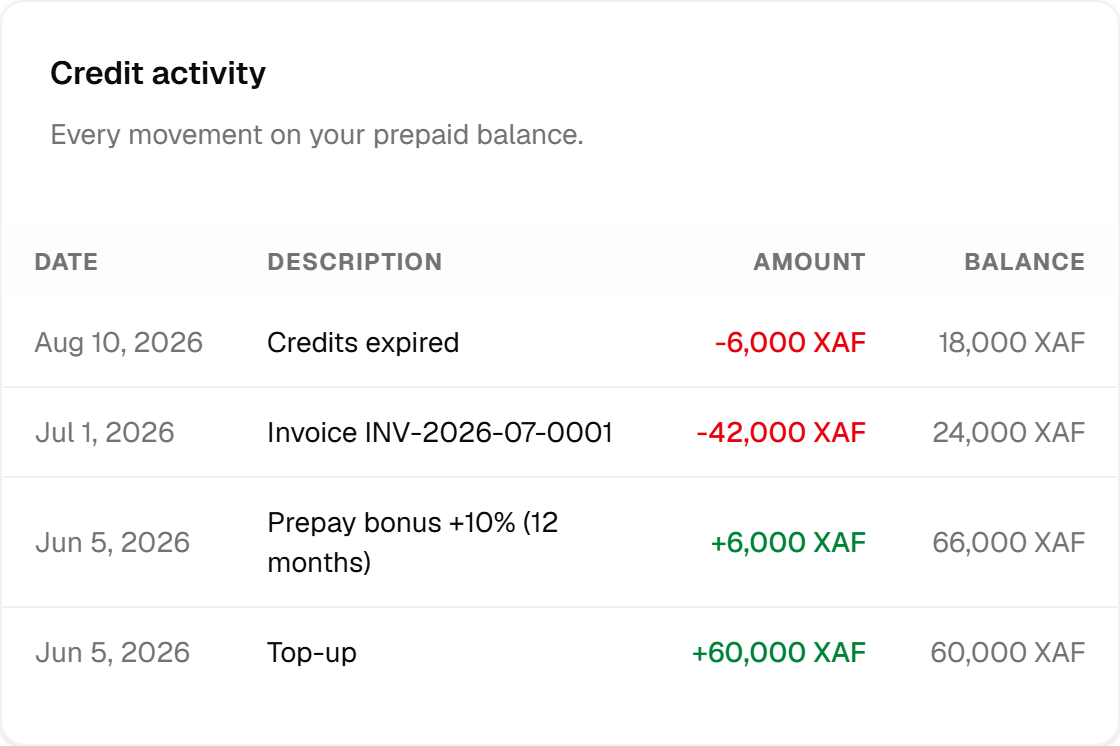
Credit activity is the full ledger, newest first: top-ups, bonuses, invoices settled, refunds, expiries, adjustments. If a balance is not what you expected, the answer is on that list — including the expiry that quietly removed credit you had stopped counting on.
Invoices, and the four words they use
An invoice is issued per month, per currency, for what ran during the period, prorated to the days each environment was actually live. It is then settled from your balance automatically.
Four statuses, and they are shown as the platform's own words:
| Status | Meaning |
|---|---|
| PAID | Settled, from your balance. |
| OPEN | Issued and not settled — usually because the balance did not cover it. |
| UNCOLLECTIBLE | Written off after long non-payment. It is not forgiven, and it keeps the account suspended. |
| VOID | Cancelled. It counts for nothing. |
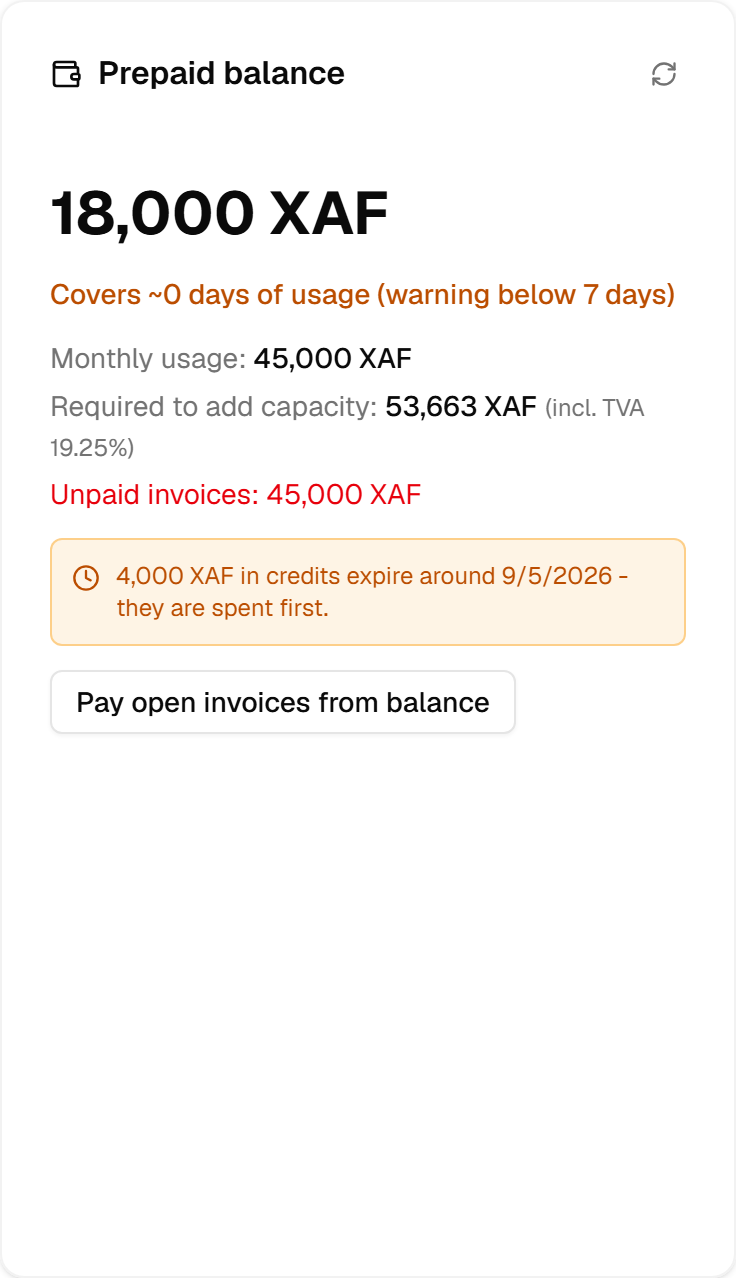
Both OPEN and UNCOLLECTIBLE count as unpaid, which is what the balance calculation subtracts. Any row opens its detail: the lines it was built from, the tax that applied at the time, and a PDF.
Tax is snapshotted onto the invoice when it is issued. If your country's rate changes afterwards, old invoices keep the rate they were issued under, because a document that changes retroactively is not a document.
The warning that comes first
Nothing is switched off without notice. While your coverage is below the threshold — seven days by default — the page carries a warning and the team is notified, repeatedly, for as long as it lasts.

This warning is proactive: it is computed from your runway, and it fires before anything is due. It is the cheapest moment to act, and it is the only stage where nothing has happened yet.
The ladder, if nothing is done
Once an invoice is overdue, a collections sequence runs daily. Each stage fires once, and the delays are counted from the invoice's due date:
- Overdue — a reminder.
- After 7 days — the account is suspended. Your environments are stopped, and creating, starting or resizing anything is refused while the suspension holds.
- After 30 days — the invoice is written off as UNCOLLECTIBLE. This is an accounting state, not forgiveness: the debt stands and the account stays suspended.
- After 60 days — the team is flagged for deletion. Flagged, not deleted: removing environments is never automatic, and always requires a human decision.
Settling the invoices resets the whole machine. Top up, use Pay open invoices from balance, and the suspension lifts — your environments restart when you start them, not before, so you choose the moment.
Those delays are configurable by the platform; the order never changes.
Who can see and do what
Three separate permissions, because these are three different jobs:
- billing.view — see the balance, the invoices and the ledger.
- billing.topup — pay: top up, redeem a coupon, settle open invoices.
- billing.manage — change the billing country, which changes the currency and the tax.
A team member without billing.view never sees this page at all. That is the point: a developer who
deploys does not need to see what the company is paying.